A comprehensive assessment arguing that deep defence, intelligence, monetary, and technological ties to the United States and Israel have produced structural constraints on UAE sovereignty — and that the 2026 Iran war exposed the costs of that bargain.
“A growing body of evidence — spanning defence contracts, intelligence arrangements, monetary architecture, technology dependency, and the catastrophic costs of the 2026 Iran war — lends substantial credibility to the analytical position that the United Arab Emirates has surrendered meaningful sovereignty across three strategic domains: security, defence, and economic independence.”[A]
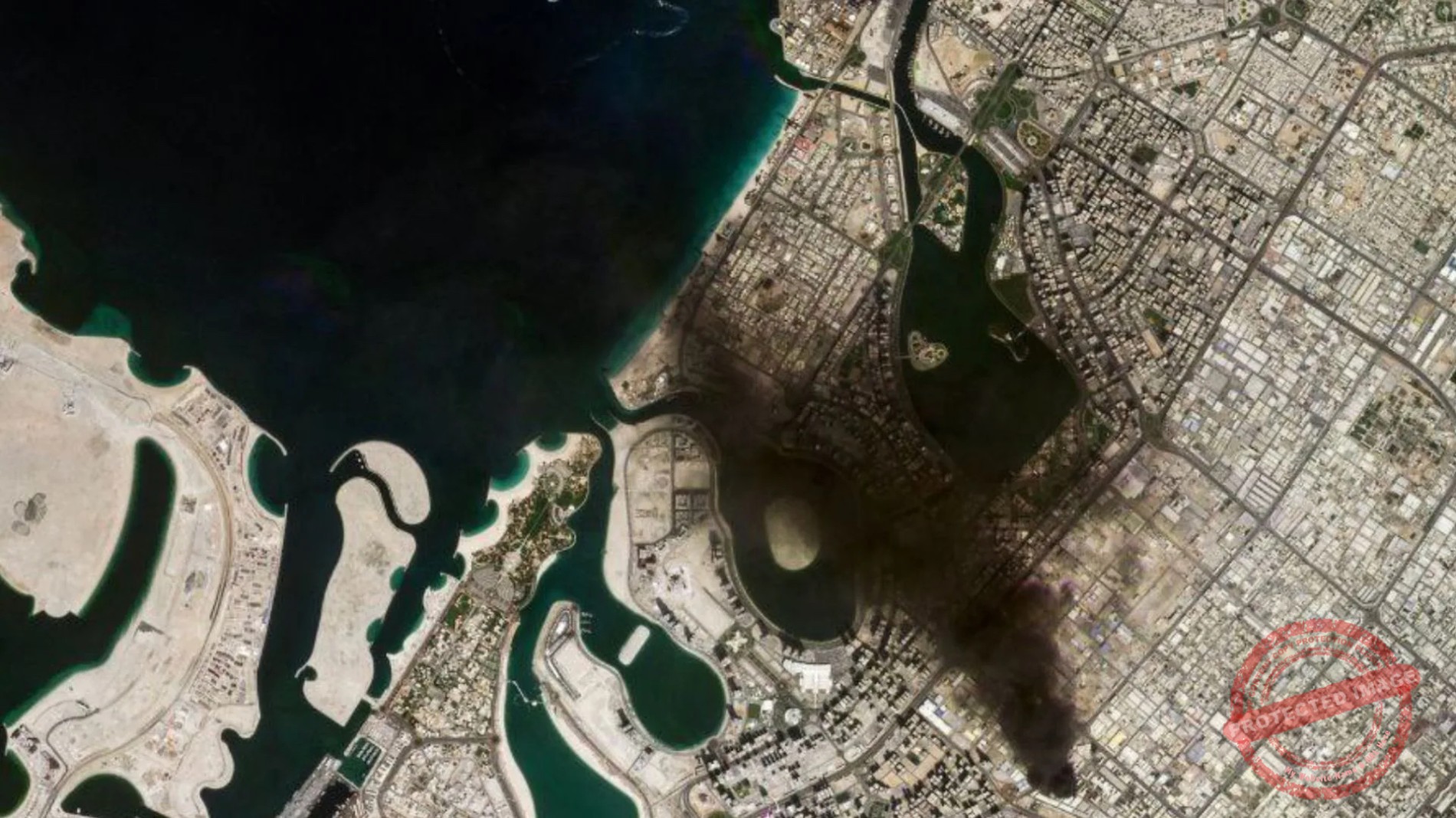
Black smoke over Dubai after Iranian missile interceptions during the 2026 conflict. (Mashable.)
“By late March, Iran had launched 398 ballistic missiles, 1,872 drones, and 15 cruise missiles at the UAE — making it the most targeted country in the conflict after Israel.”[B]
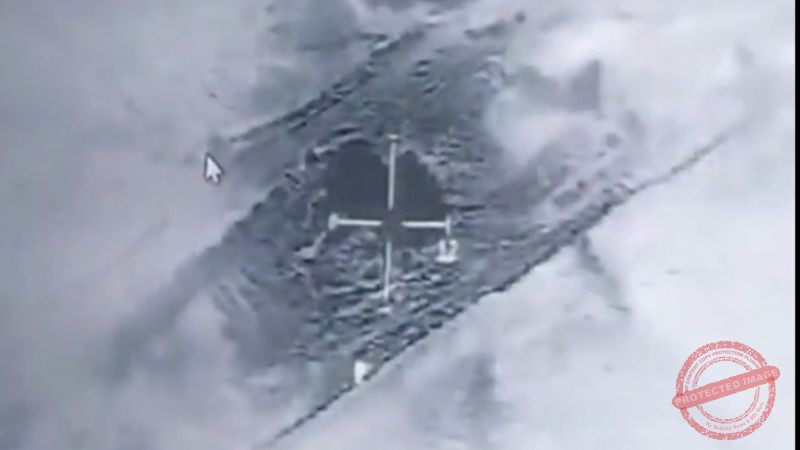
Satellite image of a destroyed ballistic missile site after strikes in the Gulf theatre. (CNN)
I. Executive Summary
A growing body of evidence — spanning defence contracts, intelligence arrangements, monetary architecture, technology dependency, and the catastrophic costs of the 2026 Iran war — lends substantial credibility to the analytical position that the United Arab Emirates has surrendered meaningful sovereignty across three strategic domains: security, defence, and economic independence.[1]
This assessment does not argue that the UAE is a passive, unwilling subject. Rather, it contends that Abu Dhabi’s ruling elite has made a rational, if ultimately asymmetric, bargain: trading sovereignty for regime security, prestige, and access to the most advanced military technology on earth.[1]
What has emerged is a relationship that critics across the political spectrum — from progressive journals to Transnational Institute analysts — increasingly describe using the language of “sub-imperialism,” “clientelism,” and “structural dependency.”[1][2][3]
The 2026 Iran war has provided the most acute real-world test of this arrangement, and the results have been damning: the UAE has absorbed more missile and drone strikes than Israel itself, the country whose alliance drew it into the conflict, while losing over $120 billion in market capitalisation and enduring the near-total disruption of its globalised economic model.[4][5]
II. Historical Foundation: The Architecture of Dependency
From Protectorate to Client State
The UAE’s subordination to external guarantors is not a post-2020 phenomenon. It is the continuation of a structural logic stretching from British protectorate status (pre-1971) through the Cold War era realignment toward the United States.[1]
Since the late 1960s, the UAE has increasingly relied on the US for defence, hosting US troops in military bases and consistently advancing US regional interests — from supporting Afghan Mujahideen against the Soviets to backing Iraq in its war with Iran, to joining the US in the Balkan interventions.[1]
The 1990 Iraqi invasion of Kuwait constituted the defining trauma. Confronted with a neighbour capable of swallowing a Gulf state, the UAE cemented its position as a willing host for American military power.[6]
Al Dhafra Air Base near Abu Dhabi became the forward hub of the 380th Air Expeditionary Wing — comprising ten aircraft squadrons, MQ-9 Reaper drones, intelligence and surveillance platforms, tanker refuelling aircraft, and the Gulf Air Warfare Center, which trains approximately 2,000 participants annually.[6][7]
The UAE did not merely invite American forces; it embedded itself so deeply in the US Central Command (CENTCOM) structure that extraction would require dismantling a generation of joint operational doctrine.[7]
The Abraham Accords: Normalisation as Strategic Entrenchment
The September 2020 Abraham Accords represent the most visible public crystallisation of a long-standing covert realignment.[8]
Israel’s Mossad chief Yossi Cohen visited Abu Dhabi for security talks within days of the announcement, discussing “cooperation in the fields of security” with UAE National Security Adviser Sheikh Tahnoun bin Zayed Al-Nahyan.[9][10]
Crucially, intelligence and surveillance cooperation between the UAE and Israel pre-dated the Accords by at least seven years — the UAE having signed a contract with NSO Group to licence Pegasus spyware as early as August 2013.[8][21]
The Accords were in fact the public legitimisation of what had been a secret architecture. As one academic paper in Dynamics of Asymmetric Conflict concludes, “the United Arab Emirates benefits from the Abraham Accords with Israel at the defence and security levels” — a framing that, while not using the language of colonialism, acknowledges a structural dependency in which the UAE is the junior partner.[11]
III. Defence Dependency: The American-Israeli Military Nexus
US Military Presence and the “Major Defence Partnership”
In May 2025, during President Donald Trump’s Gulf visit, the US and UAE signed a Letter of Intent (LOI) formalising a “comprehensive U.S.-UAE Major Defence Partnership” — a designation previously shared only with India.[12]
The agreement established a structured roadmap for enhanced military-to-military cooperation, joint capability development, and long-term defence alignment, and welcomed the UAE into the US National Guard State Partnership Program through a partnership with the Texas National Guard.[12][1]
The language of the LOI is revealing in what it does not say: there is no mutual defence clause.[12]
As RANE Network analyst Ryan Bohl observed, “It signals that the United States is interested in one of its closest military partnerships with the UAE without formalising a mutual defence clause.” In other words, the UAE absorbs the risks of alignment — including Iranian hostility — without the formal guarantee of US protection that NATO allies enjoy. This asymmetry is the structural hallmark of clientelism rather than partnership.[12]
The F-35 Affair: Sovereignty Capped by Israeli Veto
Since at least 2013, the UAE sought to purchase America’s most advanced stealth aircraft, the F‑35.[13]
The United States repeatedly refused, citing its statutory obligation under the 2008 Qualitative Military Edge (QME) law to ensure Israel maintains “sustained military superiority” over all states in the region.[13][14]
The UAE was explicitly informed that Israel’s approval was a prerequisite for the sale.[13]
In 2020, a reported deal was brokered partly as incentive for UAE normalisation with Israel, but collapsed under conditions imposed by Washington relating to Huawei 5G infrastructure and end-use restrictions that UAE officials characterised as “a violation of UAE sovereignty.”[15][16]
The Huawei episode itself is instructive: when the UAE refused to abandon Chinese 5G infrastructure, the US threatened to restrict intelligence-sharing and ultimately froze the F‑35 deal.[16]
Israeli Defence Integration: The Elbit-EDGE Complex
Since the Abraham Accords, UAE-Israel defence cooperation has accelerated at a pace that suggests strategic integration rather than mere commercial exchange.[17]
September 2022: Elbit Systems Emirates awarded a $53 million contract to supply defence systems to the Emirati Air Force; Israel approves UAE request for the SPYDER mobile air-defence system.[17]
October 2022: Israeli-made Barak air-defence system deployed to the UAE.[17]
February 2023: First bilateral naval exercise; jointly developed unmanned maritime vessel unveiled.[17]
Late 2025: Reports of a $2.3 billion contract — described as Elbit Systems’ largest ever — for strategic air-defence solutions to the UAE.[18][19]
April 2025: UAE Mirage 2000-9 jets join US and Israeli Air Forces for a multinational exercise in Greece.[17]
By late 2025, Israeli defence exports to Abraham Accords states constituted 24% of Israel’s record $12 billion in total defence exports.[17]
A reported deal involving the UAE’s EDGE Group procuring the Hermes 900 UAV from Elbit Systems — including technology transfer and localised production — represents the first major defence-industrial partnership between the two countries.[17]
As the Washington Institute assessed, this represents “a significant step in deepening strategic alignment, defence cooperation, and regional deterrence.”[11]
Semafor reported that military integration is already deeper than public discourse suggests: Israel and the UAE swap early-warning data, coordinate air-defence protocols, and have intelligence-sharing arrangements that would have been “politically unthinkable just a few years ago.”[20]
The Intelligence Dimension: Surveillance as Sovereignty Transfer
The UAE held two licenses for NSO Group’s Pegasus — one for the federal government (Abu Dhabi) and a separate one for Dubai — even though the Israeli Ministry of Defence must approve every single NSO sale to a foreign government.[21][22]
Israel therefore possessed ongoing veto power over UAE domestic surveillance operations.[21]
Abu Dhabi-based cybersecurity firm DarkMatter recruited former NSO staff and graduates of the Israel Defense Forces’ Unit 8200, offering million-dollar salaries.[23]
Leaked reporting from June 2025 described closed-door meetings at a UAE facility near Fujairah involving officers from the UAE State Security Service, Mossad, Aman military intelligence, and the CIA — developing joint surveillance of Iran’s nuclear programme through UAE satellite assets integrated with Israel’s Ofek satellite series.[23][8]
Project Raven, originally developed by the UAE with NSA assistance to monitor domestic dissent, has reportedly evolved into a regional surveillance platform now integrated with Mossad intelligence pipelines.[23]
IV. Economic Subordination: The Dollar System and the Investment Pledge
Monetary Sovereignty Surrendered: The Dollar Peg
The UAE dirham has been pegged to the US dollar at 3.6725 since 1997.[24]
As the dirham is pegged to the dollar, the UAE cannot freely adjust interest rates according to domestic economic conditions; monetary decisions in Washington directly influence borrowing costs and liquidity across the Emirates.[25][26]
The Bank for International Settlements has noted that the UAE’s central bank must ensure an “almost unlimited amount of US dollars” to back any demand against the dirham.[27]
April 2026 reports indicated the UAE sought a currency swap line from the United States during the Iran war.[28]
The $1.4 Trillion Investment Framework: Economic Integration or Tributary Relationship?
In March 2025, following a meeting between Sheikh Tahnoun bin Zayed and President Trump, the UAE committed to a 10-year, $1.4 trillion investment framework in the United States.[29]
This came on top of an existing $1 trillion economic relationship, and in May 2025 Trump’s Gulf visit generated an additional $200 billion in commercial deals, bringing the total of US-Gulf agreements to over $2 trillion.[30][31][32]
ADNOC deepened energy partnerships with US companies during Trump’s visit, with the enterprise value of UAE energy investments in the US projected to reach $440 billion by 2035.[33]
A joint US-UAE AI Campus in Abu Dhabi — expected to reach 5 gigawatts — will be run by G42 and American hyperscalers, with Microsoft having invested $1.5 billion in G42 as part of a broader $15.2 billion UAE commitment.[34][35][36][37]
The Tech Dependency Loop: G42, AI, and Technological Vassalage
G42, the UAE’s flagship AI company chaired by Sheikh Tahnoun, was previously entangled with Huawei and later accepted Microsoft investment under conditions that included severing certain Chinese ties.[36][37]
G42’s board now includes Microsoft’s President Brad Smith, and the UAE’s strategic AI infrastructure is being co-built with significant US corporate participation and oversight.[36]
V. The 2026 Iran War: The Bill Comes Due
The UAE as the Most Targeted Country After Israel
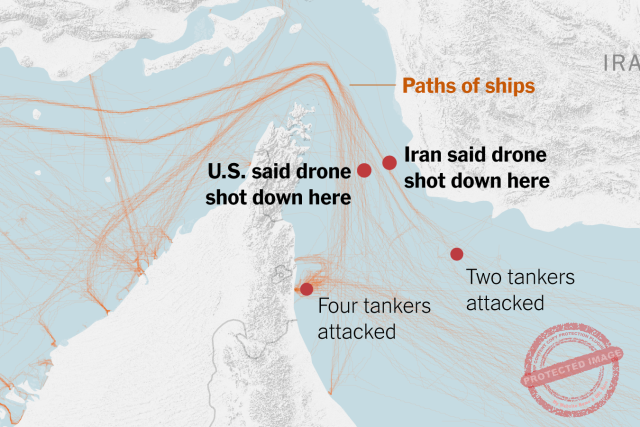
The Iran war began on 28 February 2026.[4]
By late March, Iran had launched 398 ballistic missiles, 1,872 drones, and 15 cruise missiles at the UAE — making it the most targeted country in the conflict after Israel.[4]
Over 18,400 flights had been cancelled, and more than $120 billion had been wiped from market capitalisation on Dubai and Abu Dhabi exchanges.[4]
CNN reported that the UAE was paying the price for the US and Israel’s war with Iran, and analysts argued Dubai’s centrality to the global economy made it a target.[5]
Goldman Sachs projected that if the conflict persisted until the end of April 2026, the UAE and Saudi Arabia could see GDP contractions of 5% and 3%, respectively.[38]
The Economist Intelligence Unit revised UAE 2026 growth to 1.5%, down from a previous forecast of 4%.[39]
The closure of the Strait of Hormuz was costing Gulf governments approximately $1.2 billion per day in lost energy revenue at market closure rates.[40]
The Backlash: Questioning the American Bargain
Prominent Emirati political scientist Abdulkhaleq Abdulla publicly called to “shut down American military bases in the UAE.”[41]
Reports in April 2026 indicated the UAE was “reassessing security ties with the United States,” while the UAE embassy simultaneously reaffirmed the $1.4 trillion investment pledge.[42][43]
VI. The “Sub-Imperial” Analytical Framework
Neither Colony Nor Sovereign: A Hybrid Position
The most analytically precise framework for understanding the UAE’s position is that of the sub-imperial state — a concept developed within dependency theory and world-systems analysis.[2]
The Spectre Journal described the UAE as a peripheral nation that engages in imperialist practices within its own region while remaining dependent on the United States.[2]
The Transnational Institute argued the UAE aligns with the US in its animosity towards Iran and its normalisation of relations with Israel, creating mutual dependence.[1]
The UAE projects power across Africa (Libya, Sudan, Somalia), Yemen, and the broader Middle East while operating within structural constraints imposed by Washington and Tel Aviv.[1][3]
The “No Enemies” Façade
The UAE has long projected a “no enemies” diplomatic posture — maintaining relations with Iran, Turkey, Qatar, and occasionally Russia and China while deepening American and Israeli alignments.[44]
Critics argue this “niche diplomacy” is the strategic sophistication of a dependent actor that cannot afford genuine strategic autonomy.[44][45]
VII. Counterarguments and Their Limits
The Agency Argument
The UAE signed the Abraham Accords voluntarily and made large investment pledges of its own accord.[11][29]
Academic analyses argue normalization reflected “neoliberal foreign policy” and domestic interests of status, stability, and empowerment.[46]
Nevertheless, the UAE remains constrained by procurement vetoes, integrated intelligence pipelines, and monetary constraints that limit sovereign choice.[13][21][24]
The Diversification Argument
The UAE has diversified arms suppliers — purchasing Rafale jets from France, SAM systems from South Korea, and Barak systems from Israel — while maintaining relations with China.[47][48]
SIPRI’s 2025 data shows the UAE saw a 19% decrease in arms imports compared to 2015–19, reflecting post‑Yemen drawdown and EDGE Group development.[47]
The US remained the UAE’s primary arms supplier in earlier periods, accounting for 64% of imports between 2016 and 2020.[49]
VIII. The Palestinian Dimension: Normalization’s Structural Cost
The Abraham Accords require the UAE to maintain relations with Israel despite ongoing conflict in Gaza and international legal findings referenced by human rights organisations.[50]
An Al‑Zaytouna Centre study found normalization did not deliver positive indicators for normalizing Arab countries across political stability, democracy, military expenditure, and R&D.[50]
Despite Israel’s ongoing war in Gaza, UAE‑Israel bilateral trade reached $3.24 billion in 2024, an 11% increase over the previous year.[51]
IX. Conclusions: The Costs of the Faustian Bargain
The analytical case for the UAE as a quasi-colonial dependency of the American-Israeli order rests on the convergence of five structural features.
Military dependency: A US military infrastructure so deeply embedded that, during the 2026 Iran war, it is American THAAD systems — not UAE sovereign capabilities — that intercept missiles over Dubai.[3][4]
Israeli veto power over armament: The formal QME law gives Israel ongoing structural authority over what weapons the US will and will not sell the UAE.[13][14]
Intelligence integration: From Pegasus to Project Raven to the Fujairah intelligence arrangements, the UAE’s surveillance architecture is co-managed by Israeli and American actors.[21][23]
Monetary subordination: The dirham peg to the dollar outsources the UAE’s monetary sovereignty to the Federal Reserve, while the $1.4 trillion US investment framework cements a tributary economic relationship.[24][29]
Technological vassalage: The UAE’s AI and digital infrastructure future is being co-built under US corporate oversight, with Chinese alternatives actively excluded under American pressure.[36][37]
The UAE is not a colony in the 19th-century sense. Its ruling elite retains genuine control over enormous domestic resources and projects significant regional power in its own right. But it exercises that power as a sub-imperial actor operating within a framework of structural dependency — advancing American and Israeli regional interests in exchange for security guarantees, weapons access, and the preservation of an authoritarian rentier system that neither Washington nor Tel Aviv have any incentive to destabilise.[1][2][3]
As the 2026 Iran war demonstrates, the bill for this bargain is now arriving — and the UAE, which did not start the war and expressed no desire for it, is absorbing costs that rival those of the belligerents whose alliance drew it into the conflict. The question for Abu Dhabi is whether it possesses the strategic imagination to renegotiate the terms before the architecture becomes a permanent condition of its existence as a state.[4][5]